Blog articles
UK SMEs Are Turning to Alternative Finance now more than ever. Here’s what five years of search data tells us.

Things are shifting in the UK SME finance market. Over the past 12 months, demand for alternative working capital solutions has risen sharply – and the data backs it up.
At Teybridge Capital Europe, we recently analysed five years of Google Trends search data across the UK finance market. Search data isn’t a perfect proxy for demand, but it’s one of the most honest real-time signals we have – it reflects what business owners are actually thinking about, often before they pick up the phone. What we found was clear: UK SMEs are increasingly looking for fast, flexible working capital, and the trend is accelerating.
What the Data Shows About Alternative Finance Trends in the UK:
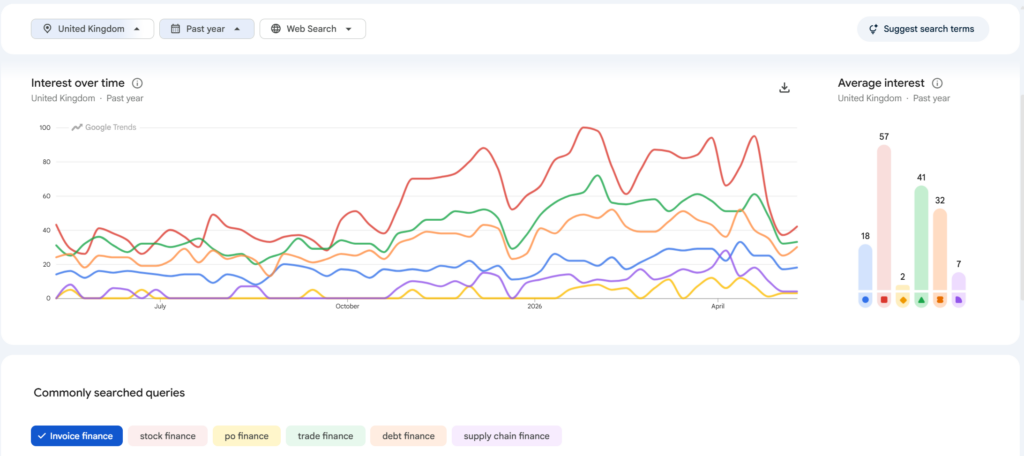
Google Trends UK – Past 12 Months: Invoice finance, stock finance, trade finance, debt finance, Teybridge Capital
Here’s how the 12-month averages stack up across the most recent period:
Stock Finance Avg. index: 57 – the highest of all categories tracked
Trade Finance Avg. index: 41 – consistently strong throughout the year
Debt Finance Avg. index: 32 – solid and stable demand
Invoice Finance Avg. index: 18 – established and steadily researched
Supply Chain Finance Avg. index: 5 – small but growing fast
PO Finance Avg. index: 2 – niche but present
But if we look at the past 5 years of data, here’s where things get really interesting:
Across five years of UK search data – from May 2021 to May 2026 – all major working capital categories remained broadly stable… until late 2025. Then, from October 2025 onwards, something changed. Search interest spiked sharply upward across almost every category simultaneously. That’s not a seasonal pattern, that’s a strong indication of a structural shift.
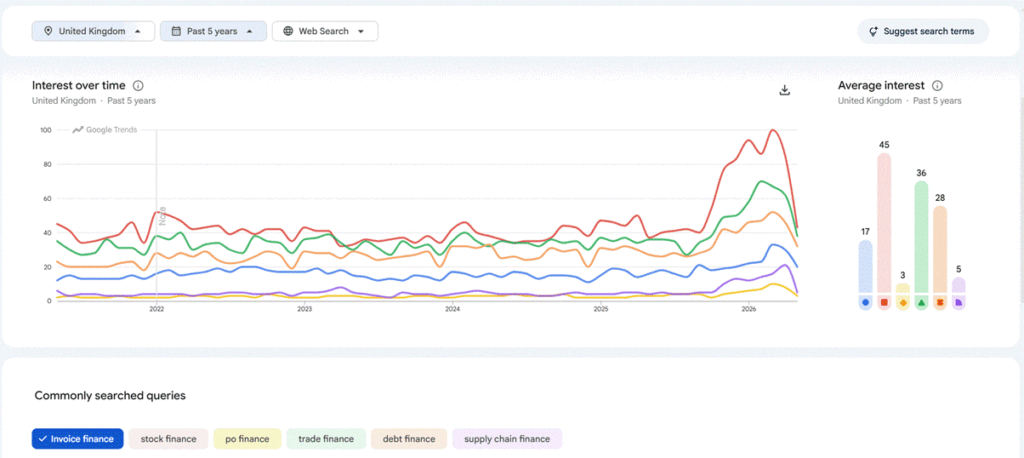
Google Trends UK – Past 5 years: Invoice finance, stock finance, trade finance, debt finance, Teybridge Capital
When you look at where these categories are now versus their 2021–2024 baseline, the scale of the shift becomes clear:
Stock Finance +50% – vs 2021–2024 baseline – peaked at index 100 in March 2026
Supply Chain Finance +91% – vs 2021–2024 baseline – the largest percentage increase of any category
Trade Finance +32% – vs 2021–2024 baseline – hit index 70 in February 2026, its highest in five years
Invoice Finance +29% – vs 2021–2024 baseline – reached a five-year high of index 33 in March 2026
Debt Finance +36% – vs 2021–2024 baseline – now consistently above its historical range
March 2026 was a particularly striking month. Stock finance reached an index of 100 – the maximum possible score on Google Trends, meaning it hit peak search interest relative to any point in the dataset. Trade finance and invoice finance also recorded their five-year highs in the same window. This wasn’t one category moving in isolation, it was the whole market moving at once.
Supply chain finance deserves a specific mention. A +91% increase from baseline is the biggest proportional jump of any category – and it signals something important. Businesses aren’t just managing their own cash flow, they’re thinking about their entire supply chain: their suppliers, their lead times, their exposure to disruption. That’s a more sophisticated and structural concern, and it points to a deeper shift in how UK SMEs are approaching financial resilience.
Why Late 2025?
The timing makes sense when you look at the macro environment. A number of pressures converged in the second half of 2025 that would naturally drive SMEs toward alternative finance:
- Bank lending stayed tight: Traditional lenders remained cautious throughout 2025. Many SMEs found overdrafts and term loans closed off – or were simply too slow. Alternative lenders became the practical choice, not just the fallback.
- Payment cycles stretched: Across construction, retail, manufacturing, and wholesale, extended payment terms put real pressure on cash flow – driving demand for invoice finance and trade finance.
- Q4 inventory funding: September and October are exactly when businesses start building stock for peak trading season. For SMEs importing goods, the working capital requirement spikes – which aligns precisely with the surge in stock finance and trade finance searches.
- Banks tightened risk appetite: In an environment of softer growth and inflationary pressure, banks pulled back further. Businesses turned to lenders who could move faster and structure facilities around real trading activity.
- Growth businesses came back: Many SMEs paused expansion in 2024. By late 2025, those that had weathered the tougher environment were ready to scale again – taking larger orders, importing more stock, and needing bigger working capital lines.
- Businesses started derisking: Macroeconomic uncertainty prompted many SMEs to think differently about financial resilience. Rather than waiting until they needed funding urgently, more businesses began putting working capital facilities in place proactively – so they had optionality when they needed it, not just when the pressure was already on.
(Checkout this blog on how to “control the controllables” as the macro environment continues to throw curveballs at SMEs)
What It Means for the UK Market
UK SMEs are actively seeking funding partners and demand is growing across the board. The rise in specialist finance searches has been accompanied by increased interest in broader terms like “business loan”, which tells us overall funding demand is up:
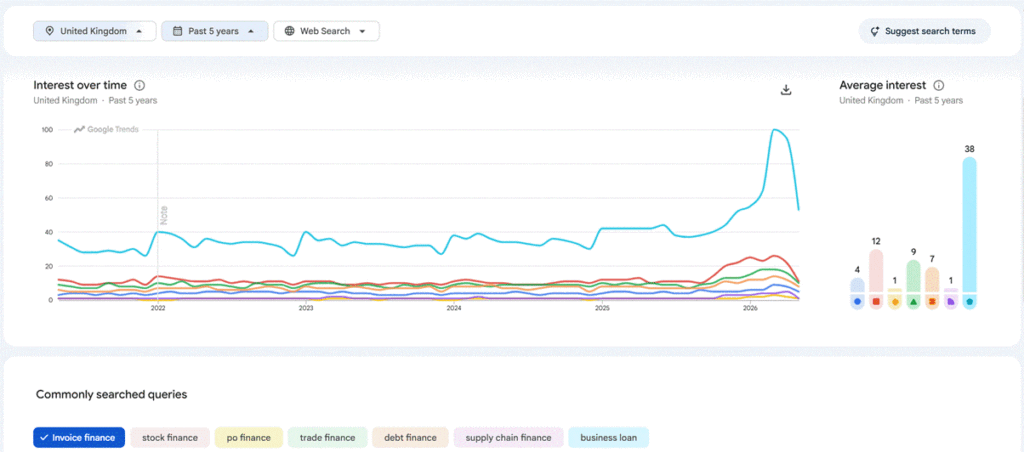
Google Trends UK – Past 5 years including ‘business loan’: overall funding demand is rising, not just shifting between products
The businesses driving this trend aren’t just managing cash flow problems; they’re scaling, securing supply chains, and positioning themselves to move for opportunities, while also preparing and de-risking for uncertain times. They need working capital that keeps pace with how they actually operate.
Flexible access to working capital remains one of the most powerful drivers of sustainable business growth.
Where Teybridge Capital Europe Fits
This data reflects what we see on the ground every day across the UK, Ireland, and Europe. The businesses that we work with are ambitious, fast-moving companies that can’t afford to wait three months for a lending decision. They need a partner who understands their business and moves with them as they grow.
Our product mix – invoice finance, stock finance, and trade finance – aligns directly with the categories showing the strongest demand in this data. And our BRIDGE platform means we can move faster and give clients greater visibility and control than traditional routes allow.
Want to explore how Teybridge Capital can support your working capital needs?
Get in touch with our team to find out how we can keep your business moving forward. Momentum Matters.