
By Clive Lennox, Head of Capital Markets, Teybridge Capital Europe
One of the most important decisions a founder will make is how they fund growth. Get it right and you preserve equity, maintain momentum and put the business in a position of strength for future funding rounds. Get it wrong and you can end up using expensive capital to solve the wrong problem.
A Real Example: From £300K to a £100M Growth Trajectory
Here’s a phenomenal example of what getting it right looks like. One of our clients is a logistics technology company that solves the issue of last mile delivery. You know it well; you ordered online and you’re obsessively tracking the delivery. The first few days are smooth and efficient, but then your parcel gets stuck, delayed, or lost right at the very end. That final stretch from the depot to your door is what the industry calls “the last mile” and our client managed to solve this issue. They came to us in May 2024 with approximately £300,000 of annual revenue. By the end of the following year, it was generating £26 million, and this year it is targeting £100 million.
What is particularly interesting is that the ingredients for success were already in place. The management team was strong, the product was solving a genuine service issue, and the market opportunity was significant.
The business still had to execute exceptionally well. What changed was its ability to access the right type of funding at the right moments in its journey, ensuring growth was supported rather than constrained by capital.
After nearly twenty years working across banking, venture capital and growth finance, I’ve seen this pattern repeatedly. Founders spend enormous amounts of time thinking about product, sales, recruitment and fundraising. Far fewer spend enough time thinking about the type of capital they are raising and whether it is actually the best solution to the challenge in front of them.
Why “How Much Capital?” Is the Wrong Question
In many cases, the question is not “How much capital can we raise?” The better question is “What type of capital do we actually need?”
Different forms of funding serve different purposes. Equity is an excellent tool for funding innovation, product development and long-term growth. Debt can extend runway without further dilution, while working capital facilities can unlock cash that already exists within the business. The companies that scale most effectively understand the difference.
The Funding Journey: How One Business Combined Equity, Debt and Invoice Finance
The logistics technology company followed a path that will be familiar to many high-growth businesses.
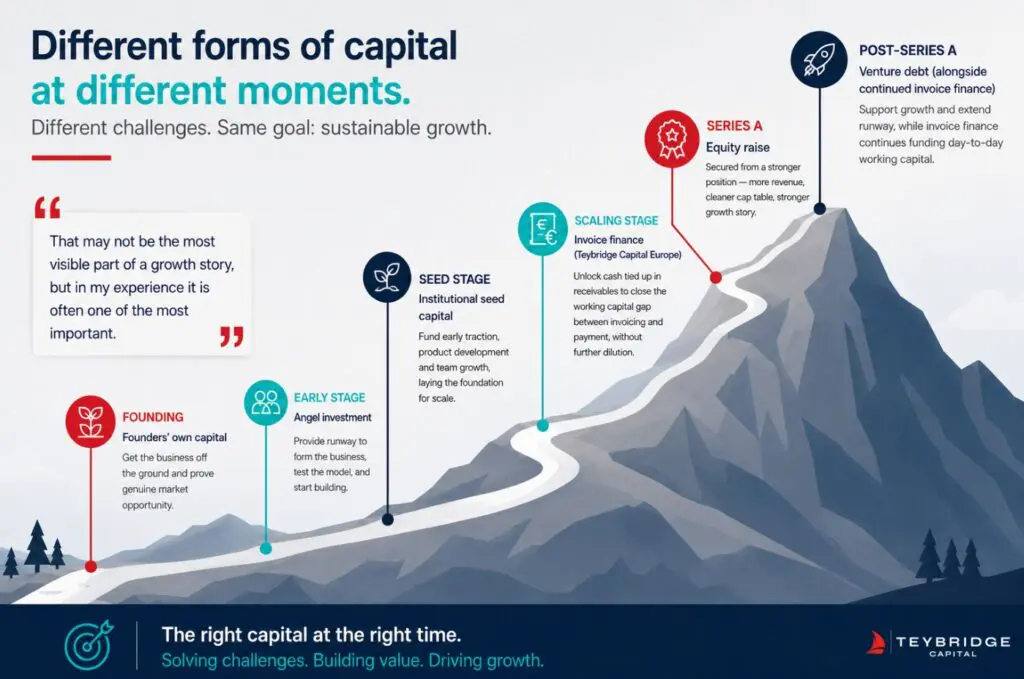
Like most entrepreneurs, the founders initially invested their own capital to get the business off the ground and prove there was a genuine market opportunity. Early-stage angel investment followed, from individuals who believed in the team and the idea before there was much revenue to speak of. This capital gave them the runway to form the business, test the model, and start building.
The next stage was institutional venture capital.
As the business gained momentum, specialist venture capital investors came on board. They provided not only growth capital, but also credibility, expertise and access to valuable networks. In return, the founders accepted a degree of dilution.
The interesting part came next.
As the company scaled, it ran into a tension every fast-growing business eventually meets. Retail clients were invoiced in weekly batches but paid on terms of 30 to 90 days, while the local drivers, depot partners, and operational staff keeping the wheels turning needed paying weekly, sometimes daily. Growth only sharpened the mismatch: every new contract brought more invoices, every invoice meant more cash sitting in limbo, and the working capital gap widened in lockstep with the business itself.
Raising more equity might have looked like the obvious fix, but equity is far from free; it dilutes founders and investors alike, spending down a resource that should be reserved for building the business, breaking into new markets, and hiring the right people, not for bridging the gap between delivering a service and getting paid for it. What the business needed instead was a solution built for its pace: one that could scale alongside it, move fast, and leave the cap table untouched.
It was at this stage that Teybridge Capital Europe became involved. Rather than raising additional equity and accepting further dilution, the company implemented an invoice finance facility that unlocked cash tied up in receivables.
The challenge was not demand, profitability or access to investors. It was timing. The business had already earned the revenue and simply needed access to the cash sooner in order to support continued growth.
As the working capital gap was being managed through the invoice finance facility rather than by burning through equity, the business was able to grow its revenue significantly in the period between rounds. When they returned to market to raise their Series A, they did so from a considerably stronger position: more revenue, cleaner cap table, and a more compelling growth story to present to investors. They secured a substantial raise, led by a prominent European technology investor.
Following the Series A, the company secured venture debt from a specialist lending division of a major global bank focused on high-growth, venture-backed businesses.
Importantly, this did not replace the existing invoice finance facility. The two funding lines worked alongside each other, each solving a different challenge. Venture debt supported growth, while receivables finance continued to fund day-to-day working capital requirements.
The results speak for themselves. Over the period we worked with the business, more than £52 million of invoice value was funded across over 600 transactions and 13 debtors. The facility grew from £2.5 million to £15 million as the company scaled, supporting a business that was growing several hundred percent year on year.
What Founders Often Get Wrong About Funding
One of the most common mistakes I see is treating every funding challenge as though it requires the same solution.
Having worked with countless businesses through Teybridge Capital Europe and throughout my earlier career in venture capital and banking, I’ve seen founders repeatedly assume they have a capital problem when in reality they have a working capital problem. Those are very different challenges, and they require very different solutions.
If you need to build a product, hire a management team or enter a new market, equity may be the right answer. If you have already delivered the product or service and are simply waiting to be paid, equity may be one of the most expensive solutions available.
Similarly, debt is not inherently good or bad. It depends entirely on the challenge you are trying to solve.
The best founders think carefully about the purpose of every pound, euro or dollar they raise. They understand that capital is not a single category and that different forms of funding exist because different challenges require different solutions.
Why Financial Visibility Matters as Much as Ambition
Businesses rarely fail to secure funding because they lack ambition. More often, they struggle because they lack visibility. Founders can usually tell you where they want the business to be in twelve months’ time. Far fewer can clearly explain what their cashflow looks like over the next ninety days.
The companies that consistently access capital on the best terms tend to have a strong grasp of their numbers. They understand their cash conversion cycle, their working capital requirements and where future funding pressures are likely to emerge. Our CFO, Graeme Rate wrote a great article on this point: Read it here.
Equally importantly, they recognise that they do not need to navigate every funding decision alone. The best management teams surround themselves with experienced finance leaders, advisors and funding partners who can help them understand which options are available and when they are most appropriate.
That clarity creates confidence. Confidence creates options.
Final Thoughts: Match the Funding to the Stage
The businesses that scale most successfully are rarely the ones that raise the most money. More often, they are the ones that use the most appropriate funding at each stage of their growth journey.
The logistics technology company mentioned at the beginning of this article is a good example. Its success was driven by a strong management team, a compelling product and excellent execution. Funding did not create those advantages, but it did allow the business to fully capitalise on them.
Different forms of capital were used at different moments to solve different challenges. Equity funded growth. Receivables finance funded working capital. Venture debt provided additional flexibility and runway. That may not be the most visible part of a growth story, but in my experience it is often one of the most important.
The best founders do not simply ask how much capital they can raise. They ask what type of capital they need, when they need it and what problem it is intended to solve.
FAQs
What’s the difference between equity and invoice finance?
Equity involves giving up a share of ownership in exchange for capital, typically used to fund product development, hiring or market expansion. Invoice finance unlocks cash already owed to your business by customers, without diluting ownership; making it suited to closing working capital gaps rather than funding new growth initiatives.
When should a scaling business use invoice finance instead of raising equity?
Invoice finance is most appropriate when a business has already earned revenue but is waiting on customer payment terms (often 30–90 days). Rather than raising equity to bridge that gap, invoice finance releases the cash already tied up in receivables, preserving ownership for founders.
Can invoice finance and venture debt work together?
Yes. As shown in this example, venture debt and invoice finance can run alongside each other, each solving a different challenge: venture debt supporting growth investment, and invoice finance funding day-to-day working capital.
Why do founders often raise the wrong type of capital?
Founders frequently focus on how much capital they can raise rather than what type of capital actually matches their challenge. A working capital gap and a growth capital need require different solutions; confusing the two can mean paying an expensive price for the wrong type of funding.